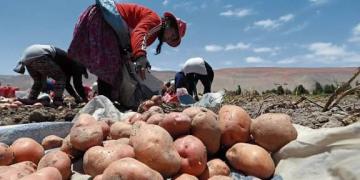
Cuba boosts seed production for potato cultivation
he country has decided to promote the development and production of domestic seeds.

Given the high cost of imported seeds for a staple and widely consumed food like potatoes, our country has decided to promote domestic seed production using biotechnological methods. The work of scientists at the Plant Biotechnology Institute (IBP) of the Marta Abreu Central University of Las Villas has been crucial in this endeavor.
This effort reflects the commitment to achieving the nation’s food sovereignty, a goal that takes on even greater relevance in a context marked by the intensification of the economic blockade imposed by the northern neighbor.
Since its inception, the IBP’s primary mission has been to support local potato seed production to reduce dependence on imports. This idea, which is gaining traction among producers and managers, is emerging as an effective solution to replace costly external seed purchases.
Globally, potato production through in vitro culture of axillary buds is a well-established technique that allows for the generation of in vitro plants and microtubers. These elements constitute the core of the plant material for pathogen-free seed production programs. Produced under controlled aseptic conditions, the microtubers can be transferred to greenhouses or the field, where they develop into minitubers. Subsequently, these minitubers are used in other multiplication schemes to obtain seed tubers.
Regarding this project, engineer Alfonso Gil Padrón, coordinator of the potato program in the province, highlighted the collaboration between the prestigious scientific institute, the network of biofactories, the seed company, and the producers. This joint effort is making a reality of an idea promoted by Fidel Castro that promises significant savings for the country.
During the current season, Villa Clara, considered a pioneer in this initiative, managed to plant 17 hectares using domestically produced seed from the previous year. In addition, another 7.5 hectares were planted with minitubers provided by scientific institutions, whose main objective is to generate more seed for use in the next agricultural season, explained Gil Padrón.
This model has allowed for sustained growth in the number of producers participating in the project; currently, there are ten in municipalities such as Camajuaní, Encrucijada, Placetas, Santa Clara, and Cifuentes. He also mentioned that more than two hectares have been planted at state-owned agricultural enterprises in Remedios and Valle del Yabú, in the provincial capital.
To understand the importance of this project, it’s worth noting that the 7.5 hectares planted with minitubers this year have the capacity to generate around 56 tons of new seed. This would be enough to plant approximately 14 hectares during the next season, according to the specialist.
An economic alternative that benefits the country
Asnel Bacallao Muñoz is one of the farmers who has decided to plant potatoes using locally sourced seed. So far, his experience has been positive, and he expects to obtain good results in both yield and profitability.
A member of the 17 de Mayo Credit and Services Cooperative (CCS) in Santa Clara, Bacallao ventured into potato cultivation for the first time last year using imported seeds, obtaining favorable results. This encouraged him to continue the challenge this year, although this time he opted to try domestically produced seeds.
Potatoes are a highly technical crop that demands resources, constant attention, and precise agricultural management. Otherwise, there is a risk of losing the entire harvest. However, Bacallao expresses his satisfaction with the support received from the seed production company and highlights the good condition of his crops.
The producer emphasizes the importance of maintaining rigorous control over soil moisture, applying fertilizers at the appropriate times, and controlling weeds. With these basic practices and favorable weather, there is no reason to distrust the use of domestic seeds.
Harvesting is scheduled to begin on their farm next week. Based on initial assessments, the crops are in excellent health and are expected to yield good results and generate significant economic returns, thus recouping the investment made.
Although he acknowledges that the tubers might be somewhat smaller compared to those obtained last year using higher-quality imported seeds, Bacallao believes this new option has great potential. In the country’s current economic climate, choosing these seeds is a strategic necessity for reducing costs, as relying on expensive imports is no longer viable.
Fuente: granma.cu