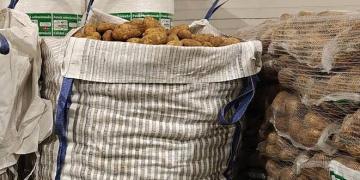
EU potato farmers experience harsh market downturn
Producers are uncertain about how to manage the surplus of potatoes.
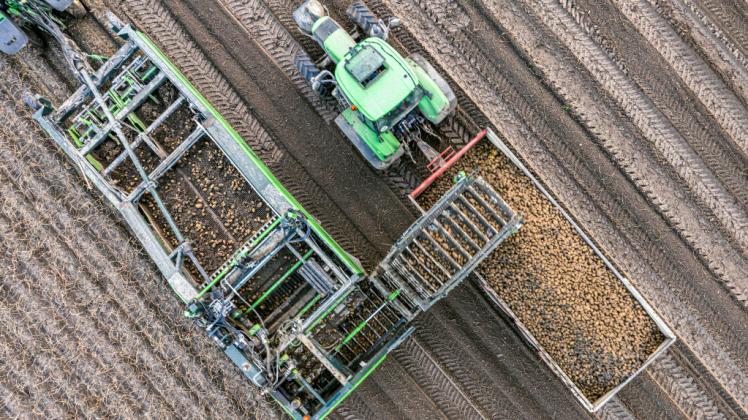
After years of tight supply that pushed prices higher, Europe’s potato sector is now grappling with the opposite problem: overproduction and collapsing prices.
Over the past decades, the EU potato market has been increasingly profitable. Production declined by nearly 40% between 2000 and 2023, driven by climate change, lower consumption, and stricter pesticide rules, which pushed prices up.
But today, the situation has reversed, with growers drowning in cheap potatoes. In 2025, potato prices fell by 22% compared with 2024, a year that had already seen a decline.
The reason is simple: motivated by high prices, many farmers switched to growing potatoes. To meet demand, “France needed roughly 40,000 additional hectares of potatoes by 2030,” says Geoffroy d’Evry, president of the national potato producers’ organisation (UNPT). “That shortfall was filled within a single year.”
D’Evry, who also chairs the potato working group at Copa-Cogeca, representing EU farmers and agri-cooperatives, and who is president of the North-Western European Potato Growers’ Association (NEPG), says that in Germany, France, Belgium and the Netherlands, the volume needed to meet demand is typically about 24 million tonnes. “This year we harvested 27 million tonnes,” he says.
Demand, however, has not kept pace.
Export opportunities outside the bloc have shrunk because of geopolitical tensions. US President Donald Trump’s tariff policies have “dampened business enthusiasm,” d’Evry says.
Currency moves have also hurt. The euro-dollar exchange rate has weakened European producers’ competitiveness against newer market players such as China, India and Egypt – once key clients of European suppliers. “Not only are these markets being lost, but they are also becoming competitors in third markets,” notably in the Middle East, d’Evry says.
Poland caught in the crossfire
Poland is particularly affected. “Stocks are full,” said Tomasz Bienkowski, president of the Polish Potato Federation.
The sector is also struggling with quality issues. Heavy autumn rains damaged part of the crop, creating difficulties for processors producing fries and chips, Bienkowski says.
As a result, producers in western Europe have increasingly redirected shipments to Poland, further intensifying pressure on the local market. According to Bienkowski, western exporters are flooding Poland with cut-rate potatoes, exacerbating the price slump.
Due to the shortage of buyers, some producers are selling 100 kilograms of potatoes for as little as €3. “For some large farms, collapse is a real possibility,” Bienkowski warns.
EU ministers on Thursday pressed the Commission to curb supply constraints in the single market,…
Few alternatives
EU growers are wondering what to do with all these potatoes. In France, the UNPT launched a platform last week to redirect them towards animal feed.
But in Poland, feeding livestock would require significant changes to animal diets, Bienkowski warns. Turning potatoes into alcohol is also not viable, as distilleries generally rely on cheaper raw materials such as corn, and biogas is not a solution either, since potatoes contain too much water. He therefore called for government support to help starch factories expand their storage and processing capacity.
Ultimately, both western and eastern European growers agree that production cuts are unavoidable. “There must be a collective awareness,” says d’Evry, who calls for reducing potato cultivated areas by 10%.
Bienkowski fears ripple effects across the supply chain, particularly for seed companies. He warns the impact could soon reach next season’s planting. “I don’t know who will buy next year’s seed,” he says.
Fuente: euractiv.com