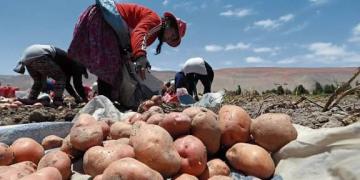
Vietnam: The potato harvest this season is facing challenges.
In recent years, a significant number of farmers in the prov. have chosen to cultivate potatoes during the winter-spring season. Unfortunately, this year’s potato harvest has been disappointing, marked by decreased yields and declining market prices.

Currently, in the fields of Po La village, located in Loc Binh commune, the sight of farmers busy harvesting potatoes is a familiar scene. However, unlike the usual energy and optimism marking previous harvest seasons, a sense of concern is evident on the faces of the local farmers this year.
Mr. Hoang Van Theo, a resident of Po La village, shared his struggles. This year, adverse weather conditions caused extensive damage to potato crops, with many suffering from root and stem rot. Forced to harvest 15 days earlier than usual, his family ended up with smaller and irregular-sized tubers. The selling price ranged between just 1,000 and 5,000 VND per kilogram—a significant drop compared to prior seasons. The price drop compounded by a 2,000 to 3,000 VND/kg decline left his family with a modest income of about 10 million VND. With surging costs of fertilizers and potato seeds, their earnings barely covered their expenses. "It’s as if we’re working for free," he noted.
Unfortunately, Mr. Theo’s story echoes throughout Loc Binh commune. Many households are grappling with similar difficulties. According to Mr. Nguyen Van Tuyen, head of the commune’s Economic Department, farmers planted a total of 90 hectares of potatoes during the winter-spring season of 2025-2026. Despite taking proactive measures—such as conducting training sessions on potato cultivation techniques and disease prevention—weather-related challenges like root and leaf diseases persisted. The average yield for this harvest season is estimated at 160 quintals per hectare—an approximate 5% decrease compared to last year.
The challenges, however, extend beyond Loc Binh commune. Across the province, potato farmers express growing dissatisfaction due to reduced yields and plummeting prices. Ms. Hoang Thi Thao, an experienced farmer from the Ky Lua neighborhood, lamented her family’s harvest results. "In previous years, from 1 sao [about 1,000 square meters] of potatoes, we would collect over a ton of tubers. This year, we only managed around 800 kilograms. Moreover, the price of potatoes dropped between 2,000 and 3,000 VND per kilo compared to last year. This season has left us with almost no profit," she disclosed.
Official data indicates that approximately 950 hectares of potatoes were cultivated across the province during this year’s winter-spring season, predominantly with German varieties. These fields are concentrated in areas with a long-standing potato-growing tradition, such as Loc Binh, Mau Son, Khanh Khe, and Ky Lua neighborhood. However, the weather was unkind from the outset. Prolonged rains coupled with persistently high humidity created ideal conditions for diseases like late blight and root rot to proliferate. As a consequence, potato plants withered prematurely or decayed rapidly. Many farmers had no choice but to conduct early harvests—10 to 15 days sooner than usual—to prevent further losses. This led to irregular quality and smaller tubers on average. Preliminary observations suggest that yields have dropped by 2 to 3 quintals per sao (200-300 kg per 1,000 square meters) compared to last season.
Another factor exacerbating this year’s challenges is increased market competition. The harvest season overlapped with potato crops from other provinces, contributing to a significant oversupply. Moreover, weak collaboration between producers and consumer companies or cooperatives has left farmers vulnerable. Without secure purchase agreements, they are at the mercy of fluctuating market demand, further driving down prices during peak harvest periods.
Mr. Nguyen Hung Thai, a trader from Hanoi involved in purchasing potatoes for distribution in the capital city, weighed in on the market situation. "Every year I come to these villages in the former Loc Binh district to buy potatoes. This year’s price reduction was inevitable since pests and diseases have affected crop quality significantly; many tubers are small and less appealing visually. On a typical day, I purchase between five and eight tons for transport to Hanoi distributors. However, I’ve had to be stricter in selecting only high-quality produce to meet market expectations," he explained.
Looking ahead, sustainable potato farming will require a concerted effort from all stakeholders—local authorities, agricultural agencies, businesses, and farmers themselves. Key priorities include adopting advanced agricultural techniques and ensuring better pest and disease management. Additionally, creating policies to attract investment in agricultural product processing and consumption—potatoes included—is vital. These actions can build long-term farming resilience and ensure that future harvest seasons no longer bring undue stress and uncertainty for local farmers.
Fuente: vietnam.vn