
“Cubans Should Stop Eating Rice and Potatoes”
“We are not Asians; that is not a Cuban habit,” a government official argues that Cubans should consider other foods.
Repeatedly debunked, the cliché that the word crisis in Chinese means “opportunity” has nevertheless been used by politicians and motivational speakers alike. This week, officials responsible for the nation’s food supply have invoked its spirit to call for a change in the Cuban diet.
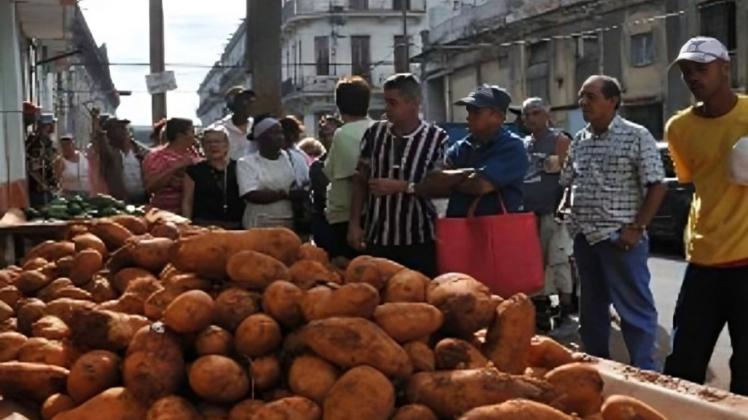
Seated with Marxlenin Perez Valdes on her program Cuadrando la Caja, Roberto Caballero, a member of the National Executive Committee of Agricultural and Forestry Technicians, and Jose Carlos Cordobes, Director of Industrial Policy at the Ministry of the Food Industry, argued that to achieve food sovereignty it would be best to change habits that clash with the reality of Cuban soils and to eliminate potatoes and rice from the regular diet.
“And once an Italian told me, quite rightly: ‘Why do you spend so much money on potatoes if you have sweet potatoes, cassava, yams, malanga—and with the money you spend on potatoes you could flood the country with all those products?’” Caballero said. The technician explained that potatoes have never adapted well to the territory, and although he did not spell out the reason—potatoes thrive in temperate to cool climates, while the island’s warm humidity favors pests—he did detail the enormous investment the country has made to plant them, keep them at appropriate temperatures, and curb the diseases that threaten them.
It is an unprofitable product, he wanted to make clear, but he put it in such a way that Perez Valdes herself was alarmed—especially when he emphasized that rice is also not an easy crop to manage in Cuba. “Roberto wants to take away even our rice! Jose Carlos, help me with this,” the host exclaimed when Caballero explained that the grain has become part of national culture without being realistic. “We are not Asians; that is not a Cuban habit,” he stressed, before suggesting that, even if it has become an established tradition, it too could change. “With the shortages there are, anything you put out for people at the local market will sell,” he asserted.
Other factors in low farm production
That part of the conversation is what has stirred the most public reaction, although there were other, more interesting segments in the program, which addressed the state of food production. The officials reviewed the factors that have led to the current dire situation, without refraining from casting a few stones at the government. They mentioned the energy situation, the passage of Hurricane Melissa, the shortage of farming inputs, and of course the US “blockade” (embargo), but they also openly criticized a policy that has been widespread on the island for decades: price caps.
“Farmers production costs have skyrocketed enormously, and then suddenly we try to regulate them by imposing price caps, and the only consequence is that production stops, because farmers cannot sell at a price lower than what it costs them to produce,” said Cordobes, who also criticized the delays caused by bureaucratization.
“There is the whole problem of nonpayment (state purchases from the farmers), the whole problem of delays in the procedures farmers have to go through. In other words, there are many things that could be resolved, but that have not been resolved this year and, in the long run, result in production levels that are totally insufficient,” he lamented.
Cordobés, however, also made remarks that surprised viewers. “Today the country has an industrial infrastructure that, with a different agricultural dynamic and by improving the country’s financial flows and being able to import the raw materials that are needed, would allow industry to respond to the population’s demands. I think that is very important,” he said—or, in other words: if things worked well in the country, there would be no problem. A truism.
The officials, satisfied that the industry “does not need investments, but rather to be used efficiently,” lamented that there is currently no foreign currency to import everything that would be needed, and congratulated themselves on the fact that the “linkages”—with private businesses—have contributed significantly and satisfactorily. “We should be closing at around 70,000 tons of products with those actors. Without them, we would not have incorporated that amount into our system. So, in some way, the industry has known how to take advantage of that scenario.”
Roberto Caballero also analyzed Cuba’s conditions, with a tradition of small farms in most of agriculture—except sugarcane… for reasons he attributed mainly to climate, soils, and salinity. “There are some who have said that we cannot be self-sufficient in food. That Cuba does not have the conditions,” he noted, and he also acknowledged that in a globalized world full sovereignty is not essential, but that it is important to accept each country’s circumstances.
“The other day we spoke with some Koreans and they said they practically don’t produce [food]. Since they have many minerals and export a lot of technology, what they do is: with the money they collect, they buy food. Ah, fine, that’s a solution. But we don’t even consider that, because even if we had that, for us it wouldn’t be valid, because they don’t have a blockade. We do,” he emphasized.
The officials also spoke at length about sustainable agriculture and said that Cuba must strike a balance with that model because, while it is important, in some sense it can contradict the state’s principles of social justice. “They solve this environmental problem very easily elsewhere. Fine, I do organic agriculture. It’s less efficient, it’s more expensive, but I sell the product at a higher price. So the person with money eats healthily and the other one keeps poisoning himself. That doesn’t fit in our system,” they said. Nevertheless, they do not rule that out, in the long run, improvements could be achieved.
The final segment was devoted entirely to trying to theorize about how to produce more, but once again everything boiled down to the usual milkmaid’s tale and to how, with foreign currency, exporting, earning revenue… things would improve. “It’s a big task we have for the year 2026, and things can be done in this scenario. With these complexities, yes, things can be done,” they promised.
Fuente: havanatimes.org


