
Switzerland: In a context of sharp decline in production, the Confederation authorizes a trial with genetically modified potatoes.
In the last ten years, 1,000 farms have abandoned potato cultivation. As part of the international CRISPS project, Agroscope will test a cisgenic variety that is more resistant to late blight.
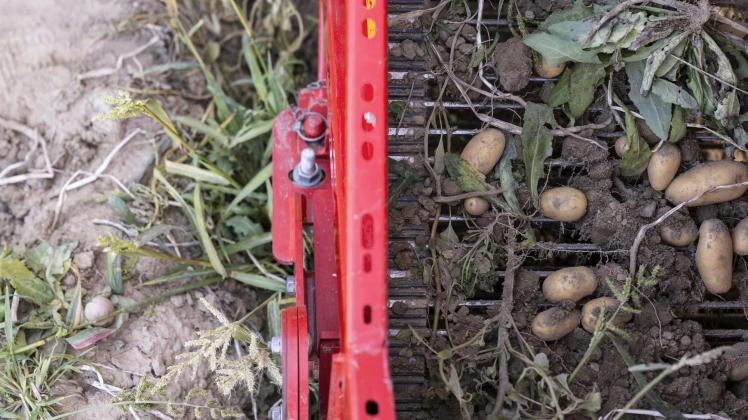
The Swiss Federal Office for the Environment has authorized the Agroscope research center to conduct a distribution trial of potatoes containing a gene resistant to a fungal disease. The Swiss Non-GMO Alliance (SAG) opposes this initiative.
This gene confers greater resistance against the fungus that causes downy mildew, according to a press release issued Tuesday by Agroscope, the Swiss Federal Institute for Agricultural Research. The Federal Office for the Environment (FOEN) announced Tuesday that it had accepted the trial, which will be conducted from this spring until autumn 2030 at the protected site of Reckenholz in the canton of Zurich.
This gene, called "Rpi-chc1", comes from the wild potato "Solanum chacoense". Agroscope is seeking to obtain information on the field performance of an experimental potato line that contains the resistance gene.
"The field trial lays the foundation for future research on potato varieties that are more resistant to disease and more tolerant to drought and heat," Agroscope stated.
A sharp drop in production
The center notes that in Switzerland, nearly 1,000 farms have abandoned potato cultivation in the last ten years. This is mainly due to the rise in diseases and the increasing frequency of heat waves or prolonged periods of rain.
This trial is part of a series of field experiments conducted within the framework of the international CRISPS project, explains Agroscope. It focuses on cisgenic varieties, whose genes are specific to the species used, but also on varieties resulting from genome editing.
The center is collaborating with Dutch and Swedish partners on two varieties of particular importance to Switzerland. In the coming years, it plans to repair existing resistance genes or selectively deactivate susceptibility genes in these varieties before the plants undergo field trials.
The authority highlights the conditions imposed on the trial.
The Federal Office for the Environment (FOME) has defined certain measures that Agroscope must implement to prevent the spread of genetically modified material outside the trial plot. According to the press release, these conditions are comparable to those of previous trials conducted in Switzerland with genetically modified potatoes.
In Switzerland, the cultivation of genetically modified plants for research purposes requires authorization. Agricultural production of these plants is prohibited due to a moratorium that extends until the end of 2030.
Opponents question the relevance of the approach.
The Swiss Alliance Against GMOs stated in a press release on Tuesday that the trial lacked scientific basis and that conflicts of interest had not been disclosed in the application. Furthermore, the gene used was reportedly already patented, which could hinder access to it.
The "Innovator" potato variety, for which the trial was requested, "exhibits low to medium susceptibility to late blight." It is intended for the production of potato chips, a form of industrial agriculture that, according to its detractors, is neither sustainable nor resource-efficient.
Fuente: letemps.ch


