Argentina: Producing and marketing potatoes costs a producer in Buenos Aires $10,000 per hectare
In 2025, producers had overstock due to a lack of local sales and also because Brazil, the main importer, shifted from the Argentine market to the European market to reduce costs. Today, there is a slight rebound, but only enough to cover expenses.
By Juan Manuel Meza
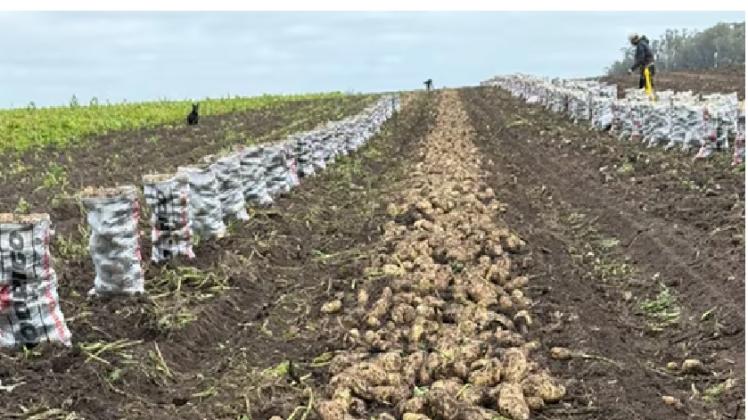
Potato production in Buenos Aires province is experiencing a precarious balance, with costs exceeding $10,000 per hectare and prices that, in practice, barely cover production costs. This situation arises within a context of economic adjustment that impacts domestic consumption and production and export conditions. This combination leaves producers with little profit margin and struggles to manage the day-to-day operations of a product considered the "cheapest" of tubers. "A lot of potatoes were thrown away last year. We had to plow hectares," recalled Sergio Costantino , director of Argenpapa, a producer, and professor of Potato Cultivation at the Faculty of Agricultural Sciences in Balcarce . The oversupply was also attributed to the diversion of potatoes destined for processing to the fresh market, due to the decline in exports.The key factor is the relationship between costs and prices. According to industry estimates, the actual cost of producing potatoes in southeastern Buenos Aires province is currently between $10,000 and $12,000 per hectare. This figure includes not only planting and input costs, but also marketing and freight, which represent one of the most significant expenses. “Marketing costs, which bring the total to over $10,000,” noted Sergio Costantino, adding that “a good year for a producer means having a profit margin of 20 to 25 percent.”
The price the producer receives is below that threshold. Today, a bag of potatoes sells for around 8,000 or 9,000 pesos at the Central Market. Translated into prices per kilo, that represents between 25 and 26 cents of a dollar. This figure falls far short of the estimated cost, which is around 36 cents per kilo.
The historical comparison reinforces the diagnosis. Over the last ten years, the average price was 34 cents per kilo, with peaks of 52 cents in 2023 and a low of 15 cents in 2025. This trend illustrates market volatility and explains part of the production dynamics.
“If you compare it to the historical average, we’re almost at the same cost as what we receive in the market,” Constantino explained. The problem is that the current price is below that average. “Right now, we’re receiving 26 cents,” he added.
The result is a scenario where the producer "breaks even or loses money." The situation is not uniform. There are differences depending on the scale and type of production. In the province, there are between 200 and 250 producers, with farms ranging from 30 to 3,000 hectares. The required investment influences the decisions: planting 1,000 hectares requires an investment of approximately 10 million dollars.
The current season is showing a trend closer to the historical average. Between 30,000 and 34,000 hectares were planted, following a 2015 marked by overproduction. That year, approximately 38,000 hectares were planted, with higher yields, which led to an oversupply and a sharp drop in prices.
The current market reflects some of that logic. The harvest is concentrated between March and April, which increases supply and puts downward pressure on prices. During this period, producers sell to cover costs and finance the next planting.
Domestic consumption remains stable. Each person consumes between 45 and 50 kilos of potatoes per year. This demand is not growing, even when prices fall. "People aren’t eating more," Costantino summarized. The stability of consumption limits the capacity to absorb increases in production.
The economic adjustment adds pressure to that system. The drop in purchasing power reduces the circulation of money and affects sales. "Every adjustment is hurting us," the specialist stated. The potato industry is exposed to this dynamic.
Meanwhile, costs continue to rise. Fuel, freight, and inputs are experiencing sustained increases. Uncertainty surrounding fertilizer prices and dependence on imported inputs complicate production planning.
The situation is even more precarious for small and medium-sized producers. Access to credit is limited, and there are no affordable financing options. “Producers don’t have access to loans with low interest rates,” Costantino warned. This restriction directly impacts their ability to sustain their operations.
The Brazil factor
In the industrial sector, the situation depends on external factors. Eighty percent of production is exported to Brazil. The lack of currency competitiveness affects these exports. The influx of potatoes from Europe into the Brazilian market over the past year has displaced Argentine production.
“With this dollar exchange rate, we couldn’t compete,” he explained. This situation generated a surplus that ended up in the domestic market, exacerbating the oversupply. The risk of this scenario repeating itself remains.
The concentration of production in Buenos Aires amplifies these effects. The province contributes 55 percent of national production and, in certain months, up to 90 percent of the supply. Any fluctuation in southeastern Buenos Aires directly impacts prices nationwide.
The production structure also limits the capacity to react. Most producers rent their land and must rotate crops every four years. This requires planning in advance and reduces the possibility of adjusting the planted area in response to market changes.
“The first thing they do is pay the rent,” Costantino pointed out. This rigidity explains why the area isn’t immediately reduced in the face of adverse scenarios.
The outlook for the sector depends on how these factors evolve. If the industrial market recovers and exports normalize, there could be a minimal profit margin. Otherwise, the scenario will continue to be marked by tight or negative results. “The current situation is one of uncertainty,” Costantino summarized. This reflects a moment in which producers continue planting, but without any guarantee of recouping their investment.
Fuente: pagina12.com.ar/2026/03/30/producir-y-comercializar-papa-a-un-productor-bonaerense-le-cuesta-mas-de-10-mil-dolares